

There is a distinct, rhythmic thrum to Indian middle-class outrage. It sounds less like a revolution and more like a massive, unthinking bhed-chaal (herd mentality). Every decade or so, a collective blackout descends upon our youth and tax-paying citizens. A new messiah arrives, a new trend drops, and millions of well-meaning people park their brains on standby to follow the loudest drumbeat.
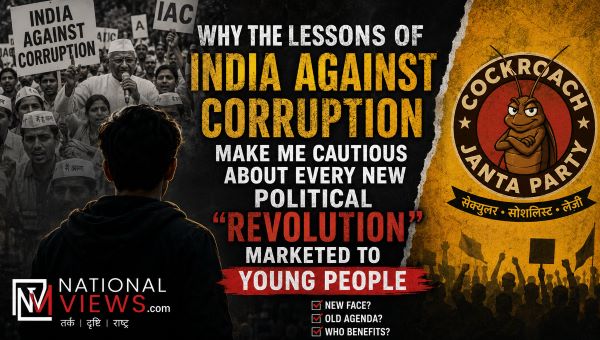
It happened in 2011 at Ramlila Maidan during the India Against Corruption (IAC) days. It is happening again today on social media, as the nation’s youth pledge allegiance to an insect – Cockroach Janta Party.
Intuition is not just a random gut feeling; it is your brain connecting the dots of history. Back then, when the IAC wave took over the country, my inner voice didn’t just whisper—it shouted that something was off. Amidst the sea of Gandhi caps and patriotic slogans, the whole thing felt deeply transactional, like a well-oiled corporate campaign disguised as a kranti (revolution).
The Ghost of 2011: India against Corruption – Anatomy of a Staged Kranti
The IAC movement was sold as a pristine, apolitical awakening—an immaculate conception of citizen anger against a corrupt government. The narrative insisted that a fasting Anna Hazare was the single moral anchor of this pure crusade.
When the hype died down and the facts came out, the reality was a cold shower. The entire phenomenon was not a spontaneous uprising, but a highly calculated political choreography.
The Funding Behind the Scenes: It later emerged through IAC members that the anti-corruption machinery was heavily lubricated and backed by the then-opposition, alongside its ideological parent. The stage was set to systematically pull down one regime and install another, using public emotion as fuel.
The Disappearing Act & Internal Agendas: A bitter public fallout quickly tore Anna Hazare and Arvind Kejriwal apart, proving that many at the top had their own calculated political agendas all along. As soon as the political transition was achieved, the anti-corruption apparatus vanished overnight. Anna Hazare was quietly packed off back to Ralegan Siddhi, his sudden irrelevance proving he was merely used as a convenient battering ram.
The Ultimate Popat of Idealism: The genuine people—the uncles who spent their savings on banners, the college students who skipped classes to fast—were left holding empty placards. Those who truly believed in the cause and later joined its political offshoot, the Aam Aadmi Party (AAP), faced a brutal reality check. The pure idealists were eventually sidelined or forced out in unceremonious purges, realizing they had just changed the managers of the system, not the system itself.
It was classic bhed-chaal. The collective ego was stoked, everyone moved like a single organism, and when the dust settled, the top leaders climbed the political ladder while the public remained exactly where they started: paying taxes and waiting for the next circus.
Also Read: Arvind Kejriwal — The Unmasking Of an Activist
Enter the Cockroach Janta Party: Irony as a Trojan Horse
Fast forward to today, and the nation is in the grip of the Cockroach Janta Party (CJP). Born out of a controversial courtroom metaphor by Chief Justice of India Surya Kant regarding legal credentials, the CJP harvested millions of youth followers in mere weeks. A generation exhausted by historic unemployment and the massive NEET-UG paper leak has found its new digital aesthetic.
But if you scratch the shiny, viral surface of this insectoid movement, the political colors start to look very familiar.
The founder, Abhijeet Dipke, is no political amateur—he is a political communications strategist who formerly managed digital campaigns for the Aam Aadmi Party. While the CJP brands itself with cool Gen-Z irony—claiming to be “Secular, Socialist, Democratic, and Lazy”—the digital footprint tells a different tale. A deep dive into the historical timeline of the founder’s social media presence reveals a worldview that has frequently echoed right-wing majoritarian narratives. The historical tweets bear the unmistakable hallmark of the very same ideological ecosystem that powers the ruling BJP.
This brings us to the terrifying parallel between the CJP and the IAC. The CJP is gathering passionate, well-meaning people using the exact same playbook from 2011. It taps into completely genuine frustration—our anger about unemployment, structural inflation, and leaking exam papers is 100% justified. But look closely at the political choreography.
According to the conspiracy theorists on the Internet,
In the high-stakes game of Indian politics, a sudden youth movement that absorbs all the anti-government frustration without actually attacking the government’s core majoritarian ideology looks suspiciously like a B-team game plan. It functions as a brilliant damage-control valve: let the youth vent their anger through memes and curated, safe protests at Jantar Mantar so that their energy never channels into a real, disruptive political opposition. History doesn’t repeat itself, but it sure does rhyme. From the Gandhi caps of 2011 to the cockroach badges of 2026, we are falling for the exact same engineered distraction.
The Red Carpets of Jantar Mantar: Cockroach Janta Party
The CJP is not a political party but they did a press conference and appointed spokes people. They didn’t approach the Delhi Police for their protest on 6th June because they thought they would not get permission. Yet they said that they will approach the Police on the 6th itself and are hopeful that the Delhi Police will co-operate. This was all very interesting.
The Cockroach Janta Party then officially marked its presence on the tarmac at Jantar Mantar, and with its arrival, the political choreography has moved from digital screens right onto the streets. When Dipke landed at the airport, he was surprisingly not arrested as expected. This stands out as a glaring anomaly when you remember how Dr. Sangram Patil was detained the second he touched down at the airport and kept in custody for almost a month over a random tweet. It seems highly probable that clear instructions were passed down to the Delhi Police to let Dipke pass smoothly.
Even more surprising is how he was granted official police permission for the protest on the exact same day it was requested. This raises a mountain of eyebrows, considering it is the Delhi Police we are talking about—an agency notorious for denying protest permissions left, right, and center under the flimsiest pretenses. It appears quite clear that instructions to greenlight this gathering were issued well in advance.
The crowd gathered at Jantar Mantar, however, looks genuinely organic. Students from various states have joined the CJP protest, actively lending their authentic voices to the cause. What is truly beautiful to see is our youth finally reclaiming the streets, standing up where a real difference can be made, and yelling for their own welfare.
Yet, the institutional handling surrounding them tells a completely different story:
The Media’s Royal Ignore: The most amusing part of this phenomenon is the sudden corporate media spotlight. The National Students’ Union of India (NSUI) has been protesting on this exact same paper leak issue for the last two weeks with a comparable crowd size, yet mainstream media gave them the absolute silent treatment. Suddenly, the CJP arrives and cameras appear everywhere. It is hard not to infer that the media was directed to cover this specific protest to the absolute best of their abilities.
The Invisible Target: Another fascinating quirk of the protest is its targeted focus. While the CJP aggressively demands the resignation of Education Minister Dharmendra Pradhan, not a single slogan has been raised against the current regime or the PM himself. This selective accountability is quite a feat, considering the union cabinet is fundamentally the structural responsibility of the Prime Minister.
This brings us back to the terrifying parallel between the CJP and the IAC. The CJP is absorbing passionate, well-meaning people using the exact same safety-valve playbook from 2011. In the high-stakes game of Indian politics, a sudden youth movement that vacuums up all the anti-government frustration.
The Illusion of the “Good Spokesperson”
The most heartbreaking part of this loop is watching history repeat itself through individuals. The CJP recently announced three official spokespersons to lead its public messaging: Saurav Das, Vijeta Dahiya, and Ashutosh Ranka. They are process-oriented, highly articulate, smart, and genuinely clean people. They speak exceptionally well, capture the raw frustration of our generation perfectly, and give the party its intellectual credibility.
But the uncomfortable question remains: How long before they get chewed up and spit out?
The Cyclic Trap of Indian Dissent: Comparing IAC and Cockroach Janta Party
| The 2011 Precedent (IAC) | The Current Loop (CJP) |
| Genuine, clean idealists built the moral face of the anti-corruption movement. | Smart, clean, and articulate youth are building the digital credibility of the CJP. |
| The movement was swallowed by electoral mathematics and backend compromises. | The platform runs on viral reels, algorithmic hype, and selective stances. |
| Idealists either compromised their values or were pushed out in disillusionment. | The Question: Will the president, spokespersons, and members actually lead, or are they just the aesthetic window dressing? |
We have seen this film before. The brilliant minds who lent their clean images to the 2011 movement to give it legitimacy were eventually discarded once the hardcore political engine took over. Today, the genuine people who were part of that wave openly regret getting caught up in the hype. If the foundation of a movement is built on controlled opposition and behind-the-scenes compromises, even the best-intentioned spokespersons end up becoming unwitting PR agents for a completely different political agenda.
Stop Being Part of the Swarm: Wait and Watch
The youth of India do not need another party, nor do they need another gimmick—whether it’s a Gandhi cap or a cockroach badge. Every time we join a wave just because “everyone else is doing it,” we turn off our critical thinking.
The Cockroach Janta Party makes great digital content. But we must learn to separate the validity of our anger from the hidden motives of those who step forward to organize it.
Don’t become prey to the mere aesthetic of rebellion. If a movement lets you feel like a rebel without ever forcing you to question your own biases, it’s not a revolution. It’s an amusement park. And as history keeps showing us, when the ride stops, you are left standing exactly where you entered, while someone else walks away with the ticket money.
