

The SCoPEx (Stratospheric Controlled Perturbation Experiment) has emerged as one of the most debated climate science projects of the 21st century. Positioned at the intersection of innovation and controversy, SCoPEx explores whether humans can deliberately alter Earth’s climate to counter global warming. While some scientists see it as a necessary backup plan in the fight against climate change, critics warn of unpredictable consequences, especially for vulnerable countries like India. This article provides a comprehensive, fact-based overview of SCoPEx, its origins, funding, scientific purpose, and potential risks.
What is SCoPEx?
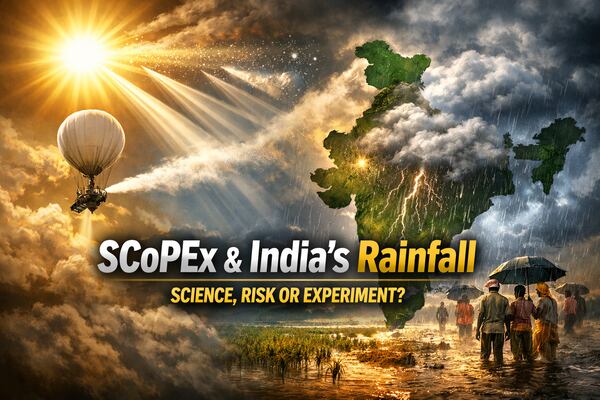
SCoPEx is a research initiative focused on solar geoengineering, particularly a method known as Stratospheric Aerosol Injection. The idea is to release reflective particles into the upper atmosphere (stratosphere) to reflect a portion of sunlight back into space, thereby cooling the Earth.
The concept is inspired by natural events such as volcanic eruptions, which have historically caused temporary global cooling. SCoPEx aims to move beyond theoretical models by conducting controlled, small-scale experiments to observe how these particles behave in real atmospheric conditions.
Origins: Who Founded SCoPEx and When?
The idea behind SCoPEx was developed around 2015 by climate scientist David Keith along with a team of researchers at Harvard University. The project formally took shape under Harvard’s Solar Geoengineering Research Program and became active between 2017 and 2024.
The experiment was led by Frank Keutsch, who served as the principal investigator. The research aimed to address gaps in scientific understanding of how aerosol particles interact with atmospheric chemistry and sunlight.
- Concept proposed: Around 2015 by climate scientist David Keith and collaborators.
- Project development: Initiated under Harvard University’s Solar Geoengineering Research Program.
- Active research period: 2017–2024
- Program launch funding: ~$23 million committed through 2024
The project was led primarily by:
- Frank Keutsch (Principal Investigator)
- David Keith
Also Read: Top 5 Companies Approved for SATCOM Services in India
Why Was SCoPEx Created?
SCoPEx was created to answer a pressing scientific question: can solar geoengineering be a viable and safe method to slow down global warming?
Despite decades of climate research, most knowledge about geoengineering comes from computer simulations. SCoPEx was designed to provide real-world data by conducting controlled atmospheric experiments. The goal was not to deploy geoengineering at scale, but to better understand its feasibility, risks, and limitations.
The main goal was to address a critical uncertainty:
👉 Can solar geoengineering safely reduce global warming?
Specifically, SCoPEx was designed to:
- Study how aerosols behave in the stratosphere
- Understand light reflection and atmospheric chemistry changes
- Improve climate models, which currently rely mostly on simulations
How the Experiment Works
- A high-altitude balloon travels ~20 km above Earth
- Releases small amounts (100 g–2 kg) of particles like calcium carbonate
- Measures:
- Light scattering
- Chemical reactions
- Atmospheric turbulence
Funding and Financial Backing: Who Funded SCoPEx?
The project received funding from a mix of institutional and private sources. A significant portion came through Harvard’s research initiatives, along with philanthropic contributions. One of the key funding channels was the Fund for Innovative Climate and Energy Research, which has been supported by Bill Gates.
In total, Harvard’s solar geoengineering research program secured funding in the range of tens of millions of dollars. Globally, research in solar radiation management has attracted approximately $200 million in funding, reflecting growing interest in climate intervention technologies.
SCoPEx funding came from a mix of:
Institutional Funding
Harvard Solar Geoengineering Research Program and Internal university research grants
Philanthropic & Private Funding
- Early funding from the Fund for Innovative Climate and Energy Research (FICER)
- Financial backing linked to Bill Gates
- Contributions from:
- Foundations (e.g., Sloan Foundation)
- Venture capitalists and private donors
👉 Total global funding for solar geoengineering research (all projects): ~$200 million spent by 2024
How Did SCoPEx Become Associated with Bill Gates?
Bill Gates’ involvement stems from his long-standing interest in climate innovation and clean energy solutions. Through his funding of climate research programs, he indirectly supported SCoPEx. This association led to widespread media attention and, in some cases, suggests that Gates intended to “block the sun.”
In reality, SCoPEx was a scientific experiment designed to study atmospheric processes, not a large-scale climate intervention project. However, Gates has publicly supported exploring geoengineering as a potential emergency tool to address climate change if mitigation efforts fall short.
Scientific Mechanism: How SCoPEx Works
SCoPEx proposed using a high-altitude balloon to release small quantities of particles, such as calcium carbonate, into the stratosphere at altitudes of around 20 kilometers. The experiment would then measure how these particles disperse, reflect sunlight, and interact with atmospheric chemicals.
This process falls under the broader category of Solar Radiation Management, which focuses on reducing the amount of solar energy absorbed by the Earth. Unlike emission reduction strategies, this method does not address the root cause of climate change—greenhouse gas accumulation—but attempts to offset its effects.
Risks and Global Concerns
SCoPEx has sparked intense debate due to its potential risks. One of the primary concerns is the possibility of unintended climate consequences. Altering the Earth’s radiation balance could disrupt weather systems, leading to uneven impacts across different regions.
Another major risk is damage to the ozone layer. Aerosol particles in the stratosphere could trigger chemical reactions that weaken ozone protection, increasing exposure to harmful ultraviolet radiation.
There are also governance concerns. Currently, there is no international regulatory framework to oversee geoengineering projects. This raises the possibility of unilateral action by individual countries or private entities, potentially leading to geopolitical tensions.
The concept of “moral hazard” is another issue. Critics argue that reliance on geoengineering could reduce the urgency to cut greenhouse gas emissions, delaying long-term climate solutions.
This is where SCoPEx becomes highly debated
1. Climate Imbalance
- Could change rainfall patterns globally
- Risk of:
- Droughts
- Floods
- Regional climate disruption
👉 Example: Studies warn it could trigger droughts in India and crop failure
2. Ozone Damage
- Aerosols may damage the ozone layer
- Could increase UV radiation exposure
3. Governance Crisis
- No global authority controls geoengineering
- Risk of:
- One country acting alone
- Climate conflicts
4. “Moral Hazard”
- Governments may:
- Reduce efforts to cut emissions
- Depend on geoengineering instead
5. Irreversible Dependency
- If started, stopping suddenly could cause:
- Rapid temperature spikes
- Severe climate shocks
Potential Impact on India
India is particularly vulnerable to the risks associated with solar geoengineering. The country’s agriculture and economy are heavily dependent on the monsoon system, which could be disrupted by changes in atmospheric conditions.
Studies suggest that stratospheric aerosol injection could weaken monsoon patterns, leading to reduced rainfall and agricultural instability. Given that a large portion of India’s population relies on farming, even minor disruptions could have significant socio-economic consequences.
Additionally, India may have limited influence over global geoengineering decisions, raising concerns about climate equity. If such technologies are deployed without inclusive governance, developing nations could bear disproportionate risks.
India is particularly vulnerable due to its climate sensitivity.
Monsoon Disruption
- Indian agriculture depends on monsoon cycles
- Geoengineering may:
- Weaken monsoon
- Shift rainfall patterns
Agriculture Risk
- 50%+ Indian population depends on farming
- Even small rainfall changes = massive economic impact
Heat vs Rain Trade-off
- Cooling Earth may:
- Reduce heatwaves
- But increase drought risk
Geopolitical Concerns
- India may have no control over global geoengineering decisions
- Raises questions of:
- Climate justice
- Global inequality
Current Status of SCoPEx
The SCoPEx project faced strong opposition from environmental groups and indigenous communities, particularly in Sweden, where initial test flights were planned. Due to these concerns, planned experiments were postponed, and the project officially concluded in 2024.
However, the end of SCoPEx does not mark the end of solar geoengineering research. Similar studies and discussions continue globally, indicating that the debate over climate intervention is far from over.
- The project faced strong opposition, especially from indigenous groups in Sweden
- Planned test flights were delayed/cancelled
- Officially, the SCoPEx project ended in March 2024
👉 However Research on solar geoengineering continues globally
Final Analysis: Hope or Threat?
Potential Benefits
✔ Could slow global warming
✔ May buy time for climate action
✔ Relatively low cost
Major Risks
❌ Unpredictable climate consequences
❌ Global governance vacuum
❌ Ethical concerns
❌ Disproportionate impact on countries like India
Conclusion
SCoPEx represents a significant milestone in climate science, highlighting both the possibilities and dangers of geoengineering. While it offers a potential tool to temporarily reduce global warming, it also introduces complex risks that are not yet fully understood.
The involvement of high-profile figures like Bill Gates has amplified public attention, but the core issue remains scientific and ethical rather than personal. For countries like India, the stakes are particularly high, as climate interventions could directly impact agriculture, water resources, and livelihoods.
Ultimately, SCoPEx underscores a critical reality: while technological solutions to climate change are advancing, they must be approached with caution, transparency, and global cooperation to ensure that the cure does not become more harmful than the problem itself.
SCoPEx represents one of the most ambitious—and controversial—attempts to engineer Earth’s climate.
It is not a conspiracy, but it is also not risk-free science.
The real concern is not just the experiment itself, but:
- Who controls such technology
- Who benefits
- And who bears the consequences
For countries like India, the stakes are extremely high—because even small climate shifts can affect millions of lives, agriculture, and economic stability.
