
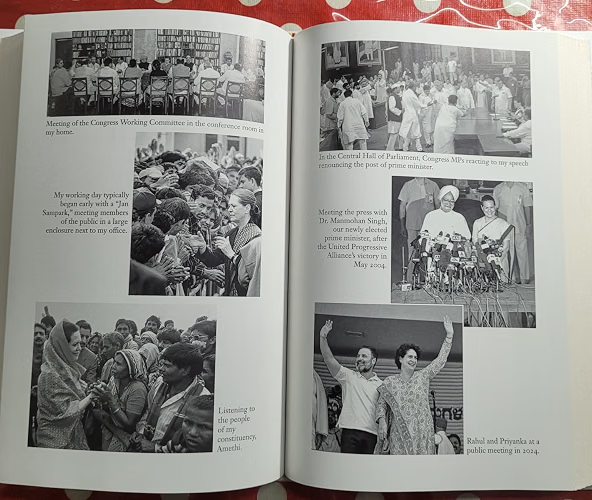

Sonia Gandhi’s long-awaited memoir, Belonging: A Journey of Love, has finally reached readers, offering an unusually personal account of a woman whose life has been closely intertwined with some of the most important chapters of modern Indian political history. Published in India by HarperCollins, the book was released on November 10, 2026, after months of uncertainty surrounding its publication. The Indian Express
The memoir is significant not simply because it comes from one of India’s best-known political figures, but because Sonia Gandhi has traditionally maintained a highly private public persona. In the book, she looks back at her childhood in Italy, her relationship with Rajiv Gandhi, her entry into the Nehru-Gandhi family, devastating personal losses and her eventual decision to enter politics.
Gandhi has repeatedly stressed that Belonging is not intended to be a conventional political book. Instead, she describes it as a personal account of her life, family and relationship with India. At the same time, the extraordinary political circumstances surrounding her life inevitably make the memoir an important document of contemporary Indian history. NDTV
Sonia Gandhi’s Belonging: A Journey of Love – From a Small Italian Town to India
One of the central themes of the memoir is the idea of belonging. Sonia Gandhi was born in Italy and grew up in a small town before moving to England as a young woman. Her life changed dramatically when, at the age of 19, she met Rajiv Gandhi while studying in Cambridge.
Their relationship eventually brought her to India. She married Rajiv Gandhi in 1968 and entered a family whose name was already deeply connected with the history of independent India. Her mother-in-law was Indira Gandhi, then one of the world’s most prominent political leaders, while Rajiv was the grandson of India’s first Prime Minister, Jawaharlal Nehru. The Tribune

The memoir reportedly explores the adjustment involved in moving from Italy to India and becoming part of a family whose private life was constantly surrounded by public attention.
For Sonia, India gradually became more than the country where she had married. It became the country she eventually considered home.
Also Read: 11 Lesser Known Facts about Sonia Gandhi’s Personal Life – Early Life, Young Days!
Love, Family and Devastating Loss
The emotional heart of Belonging is the story of family and loss.
Sonia Gandhi lived through a series of tragedies that profoundly changed her life. Sanjay Gandhi, Rajiv’s younger brother, died in a plane crash in 1980. Four years later, Indira Gandhi was assassinated by her own security guards.
Indira Gandhi’s death dramatically changed Rajiv Gandhi’s life, pushing him from a relatively private existence into the centre of national politics. Rajiv subsequently became Prime Minister.
But another tragedy followed. In 1991, Rajiv Gandhi was assassinated during an election campaign in Tamil Nadu.
For Sonia, the deaths of her mother-in-law and husband were not simply political events. They were deeply personal experiences that reshaped her family and her own future. The memoir examines how grief and responsibility eventually pushed her towards public life. NDTV
Why Sonia Gandhi Entered Politics
For years after Rajiv Gandhi’s assassination, Sonia Gandhi resisted entering active politics. She largely stayed away from the political spotlight and concentrated on her family.
Her eventual entry into politics became one of the defining developments in Congress politics in the late 1990s.
She eventually became president of the Indian National Congress and went on to become the party’s longest-serving president. Under her leadership, Congress rebuilt itself as the central force of the United Progressive Alliance, which won the 2004 general election.
Perhaps the most consequential personal-political decision discussed in the memoir is her decision not to become Prime Minister after the 2004 election.
Congress and its allies had won the election, and Sonia Gandhi was widely expected to lead the government. Instead, she declined the post, paving the way for economist and former Finance Minister Dr Manmohan Singh to become Prime Minister.
The memoir revisits that decision and the circumstances surrounding it, providing readers with Sonia Gandhi’s perspective on one of the most discussed political moments of the period. The Indian Express
Politics Appears Despite the Personal Focus
Although Sonia Gandhi describes Belonging as a personal memoir rather than a political book, politics is naturally woven throughout its pages.
The book covers decades in which the Gandhi family was at the centre of India’s political life. It also reportedly discusses the Congress party, the BJP, the RSS, the Election Commission and contemporary political developments.
According to N. Ram, who read the manuscript and interviewed Sonia Gandhi, political subjects appear as part of her broader account rather than as the sole purpose of the book. He said the memoir was not written specifically with the 2029 general election in mind. NDTV
This distinction is important because the book arrives at a politically sensitive moment. Its observations about contemporary politics have already generated strong reactions from both supporters and critics.
Also Read: Lesser Known Facts about Sonia Gandhi and Rajiv Gandhi’s Love Story & Marriage
The 1984 Riots and the Emergency
The memoir has also attracted criticism from the BJP over its treatment of difficult episodes associated with the Congress and the Gandhi family.
BJP leaders have accused Sonia Gandhi of attempting to soften or reinterpret aspects of the family’s political history. Among the issues raised are the 1975 Emergency imposed by Indira Gandhi and the anti-Sikh violence of 1984.
Sonia Gandhi reportedly describes the 1984 violence as a tragic and shameful chapter and criticises failures that allowed the violence to continue. At the same time, she defends Rajiv Gandhi against allegations of complicity. The differing interpretations have already made the memoir part of a wider political debate about how India’s recent history should be remembered. Reuters
A Book Surrounded by a Publishing Controversy
The journey of Belonging to Indian bookstores was itself controversial.
The memoir was initially scheduled to be published in India by Penguin Random House India. However, the publisher eventually decided not to proceed after disagreements over proposed editorial changes and deletions.
Reports said some of the disputed material involved references to Prime Minister Narendra Modi, the RSS, communal tensions, minorities, the Galwan episode and other contemporary political developments. Sonia Gandhi’s side reportedly opposed the proposed changes. The Indian Express
HarperCollins India subsequently took over the Indian publication, with November 10, 2026, confirmed as the release date.
The publishing controversy generated considerable anticipation even before the book reached the market.
More Than a Political Memoir
What makes Belonging: A Journey of Love different from a conventional political autobiography is its attempt to place political history within a personal narrative.
Sonia Gandhi is not merely recounting elections, governments and political battles. She is writing about the people behind the public figures — Rajiv Gandhi as her husband, Indira Gandhi as her mother-in-law, and her children Rahul and Priyanka as members of a family that experienced extraordinary loss and public scrutiny.
The memoir therefore provides an opportunity to understand the human side of a family that has been examined for decades primarily through the lens of politics.
It also offers Sonia Gandhi an opportunity to respond, in her own words, to the many biographies, political accounts and interpretations that have shaped public perceptions of her and her family.
Sonia Gandhi’s Belonging: A Journey of Love – Why the Book Matters
Belonging is likely to remain an important political and literary document because Sonia Gandhi occupied a unique position in India’s political history.
She was born in Europe but became an important figure in Indian public life. She married into the Nehru-Gandhi family, experienced personal tragedies that changed the course of Indian politics, led the Congress party for many years and played a central role in the formation of the UPA government.
Her memoir comes at a time when the legacy of the Nehru-Gandhi family remains intensely debated.
Ultimately, Belonging: A Journey of Love is both a personal story and an account of a remarkable period in India’s history. Sonia Gandhi may describe it as a story of love, loyalty, loss and finding a home, but because her personal journey is inseparable from India’s political story, the book inevitably becomes much more than a family memoir.
It is Sonia Gandhi’s attempt to tell her story in her own voice — after decades in which others have told it for her. NDTV
