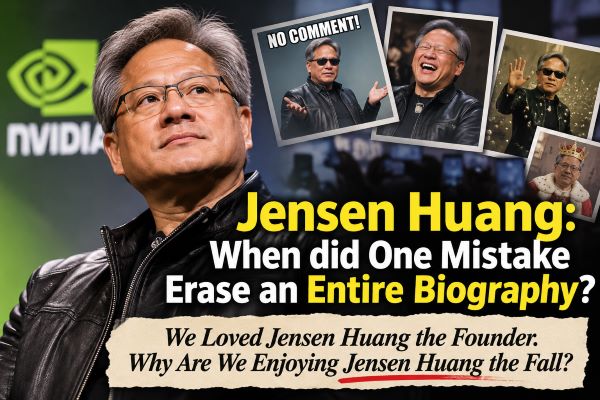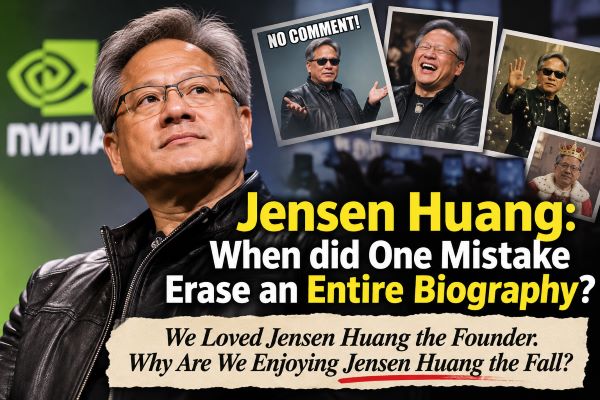

I didn’t find the Jensen Huang memes funny enough to share, make, or even react to.
Not because I have suddenly become allergic to humour. I enjoy good humour. I have laughed at corporate disasters, political absurdities, startup jargon, LinkedIn poetry and presentations where the phrase “synergy” appears more frequently than an actual idea.
But this time, I am sitting this one out.
Jensen Huang, the co-founder of NVIDIA, has become the internet’s latest punchline after a deeply personal controversy surrounding his relationships, followed by his resignation from the company he co-founded. NVIDIA confirmed that Huang resigned as president, CEO and board member on November 11, 2026.
And within hours, the internet did what the internet does best.
It turned a complicated human situation into entertainment.
AI-generated videos. Movie parodies. Fake movie posters. Recycled celebrity scenes. Jokes about NVIDIA’s own chips supposedly powering the memes about its founder.
There is, admittedly, a certain technological irony to it.
The man who helped build the infrastructure powering today’s AI revolution is now being digitally reconstructed by that very technology for the amusement of millions.
It’s clever.
It’s also where I stop laughing.
I am not defending Jensen Huang mistake
Let me make this very clear before the internet’s imaginary jury assembles.
I am not defending what Jensen Huang did.
He himself acknowledged being unfaithful to his wife and apologised to his family, colleagues, board, partners and shareholders. NVIDIA has also been dealing with serious questions surrounding the broader circumstances and has launched an independent investigation.
If someone makes a mistake, they should be accountable for it.
If there are professional, governance or security implications, those should be investigated.
If a company decides that its CEO can no longer continue, that decision deserves scrutiny based on facts, responsibilities and governance.
But accountability and humiliation are not synonyms.
Somewhere along the way, we have confused the two.
Also Read: Nvidia Becomes World’s Second Largest Company – How Did Nvidia Do It?
When did one mistake erase an entire biography?
This is the part that bothers me.
Jensen Huang did not become Jensen Huang last Tuesday.
He co-founded NVIDIA in 1993. He spent more than three decades building a company that went from graphics chips and gaming technology to becoming one of the most important companies in the global AI ecosystem. NVIDIA’s own corporate history credits Huang with leading the company from its founding, through the evolution of accelerated computing and into the generative-AI era.
There were years when NVIDIA was not the glamorous AI giant everyone wanted to put on a conference stage.
There were risks.
There were failures.
There were moments when the company could have disappeared into the enormous graveyard of technology companies that once looked promising.
Huang has spoken publicly about one particularly painful early failure involving NVIDIA’s work with Sega, describing the experience as embarrassing and humiliating—and explaining how it taught him that being a CEO was fundamentally about responsibility rather than power.
That is a career.
Thirty-three years of it.
And now, because a man made a deeply personal mistake, the internet has apparently decided that the appropriate response is to rewrite his entire biography as a punchline.
I don’t buy that.
A person is not a meme
This may be an unfashionable opinion in 2026, but I still believe that people are larger than their worst day.
We have become remarkably comfortable with reducing complicated human beings to one screenshot, one leaked message, one awkward video, one affair, one bad decision or one spectacular failure.
The algorithm loves simplicity.
Human beings are not simple.
A successful founder can be brilliant and flawed.
A CEO can build something extraordinary and make a terrible personal decision.
A person can deserve criticism and still deserve basic human dignity.
These things can coexist.
Apparently, nuance is now considered a premium feature.
The internet’s favourite sport: moral consistency
What fascinates me even more is our selective morality.
We celebrate entrepreneurs for being “disruptive,” “risk-taking,” “unconventional” and “bold.”
We romanticise founders who work eighteen-hour days, sleep in offices, break rules, challenge institutions and refuse to behave like ordinary people.
Until they do something we dislike.
Then suddenly, everyone becomes a corporate governance expert, relationship counsellor, ethics professor and family therapist—usually before finishing breakfast.
I find that amusing.
Not because ethics don’t matter.
They absolutely do.
But ethics should not begin and end with whichever scandal is currently trending.
I also refuse to confuse sympathy with absolution
There is another important distinction.
I can believe Jensen Huang should be accountable without believing he deserves to be digitally burned at the internet stake.
I can recognise that his actions hurt people without pretending that his entire contribution to technology has become worthless.
I can believe NVIDIA needs strong governance without celebrating the personal collapse of the person who helped build it.
And I can think a meme is funny without necessarily thinking it is worth sharing.
That last one may be the hardest concept for social media to understand.
Not everything that makes us laugh needs our amplification.
Founders are human beings, not mythology
Perhaps this episode also tells us something uncomfortable about how we treat founders.
We turn them into mythology.
Then we punish them when they behave like humans.
For years, Jensen Huang was presented as the leather-jacketed face of the AI revolution—the visionary founder who understood GPUs before much of the world understood what they would become.
People quoted him.
Investors watched him.
Engineers admired him.
Markets reacted to him.
Then suddenly the same person became a meme template.
That transformation says something about us too.
We don’t merely admire people anymore.
We manufacture icons.
And once we manufacture them, we seem to enjoy destroying them.
There is a difference between consequences and cruelty
Jensen Huang’s resignation is a serious corporate event, not merely a celebrity breakup story.
NVIDIA has to deal with leadership succession, governance, investor confidence and questions surrounding the circumstances that led to the crisis. Reuters has reported that NVIDIA’s board is not currently considering reinstating Huang, even as a petition supporting his return has gathered significant backing.
Those are legitimate questions.
The memes are not.
Or, more precisely, the existence of humour isn’t the problem.
The problem is when humour becomes our entire analysis.
A company that helped shape modern computing deserves more serious conversation than a collection of AI-generated videos.
And a human being who spent more than three decades building something deserves to be remembered as more than the punchline of one week.
So, no, I won’t be making the meme
Maybe that makes me boring.
That’s okay.
I would rather be boring than cruel.
I would rather discuss what Huang built, what went wrong, what responsibility looks like, what corporate boards should consider when founders become inseparable from their companies, and whether a founder’s personal conduct should determine the fate of an organisation he spent decades building.
Those are interesting questions.
“Look, Jensen is in a Bollywood movie now!” is entertaining for approximately seven seconds.
Then what?
Another meme arrives.
Another scandal replaces it.
Another human being becomes content.
And we scroll.
I don’t think every mistake should be forgiven.
But I also don’t think every mistake should erase everything that came before it.
Jensen Huang is not beyond criticism.
He is also not required to become a cartoon villain for us to acknowledge that he made a mistake.
Perhaps we can hold two thoughts in our heads at once:
He can be held accountable for what he did.
And he can still be recognised for what he built.
That isn’t defending him.
That is simply refusing to confuse accountability with humiliation.
And in an age where artificial intelligence can manufacture almost anything—including a joke at someone’s expense—I think retaining a little humanity might be the one thing worth doing ourselves.